
Basic Music Recommendation System
Overview
Overview
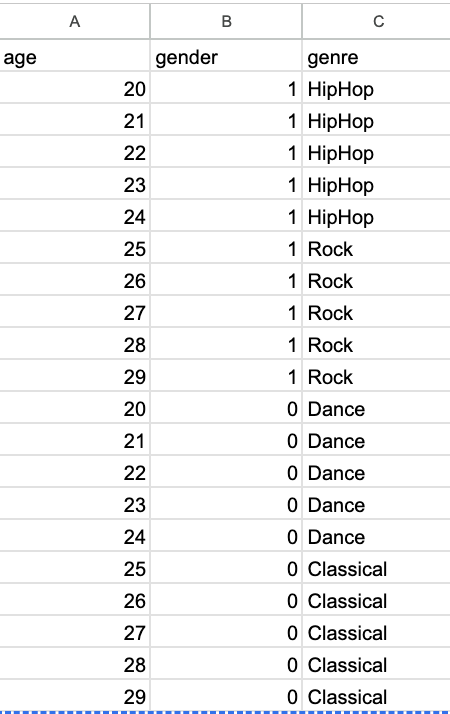
In order to investigate how predictive models might provide recommendations based on user attributes, I created this project as a machine learning exercise. I developed a simple music recommendation system using Python, Pandas, and Scikit-Learn that determines a user's favorite genre based on their gender and age.
I used a dataset with information on age, gender, and music genre to train a Decision Tree Classifier in order to construct the system. After the model was trained, I created a straightforward user interface that gathers demographic data and uses patterns found in the data to select a genre of music. I was able to obtain practical expertise with machine learning procedures, data preprocessing, model training, and prediction production through this project.
1. Prepared and Organized the Dataset
I made a straightforward user interface that requests the user's age and gender after preparing the dataset. I transformed the user's response into numerical values that the classifier could process because machine learning models need numerical inputs. As a result, data in the same format as the training dataset could be fed into the model.
In order to examine the data that would be used to train the machine learning model, I first imported the dataset into a Pandas DataFrame. Information on age, gender, and musical genre was included in the dataset. In order to help the model understand the connection between user attributes and musical tastes, I then separated the input features (age and gender) from the desired output (genre).

2. Processed User Input

3.Trained the Decision Tree Model

After the data was ready, I created a Decision Tree Classifier and used the dataset to train it. In order to find patterns that may subsequently be utilized for predictions, the model examined the connections between age, gender, and musical genre throughout this phase. I learned about the principles of supervised machine learning and model training in this step.
4. Generated Music Genre Predictions
I utilized the user's age and gender as inputs to create a prediction once the model had been trained. After analyzing the data, the classifier reported the genre that most closely matched the patterns it had discovered in the training set. This stage illustrated the ability of machine learning models to make judgments based on examples that have already been observed.

5. Displayed and Evaluated the Results

Lastly, I showed the user the anticipated genre of music and assessed if the suggestion matched the dataset's patterns. By taking raw data, building a model, accepting new user input, and generating a suggestion based on learnt associations, this finished the machine learning workflow.
Analysis and Conclusion
I was able to have practical experience with machine learning, data preprocessing, and predictive modeling with this project. I gained a better grasp of how machine learning models recognize patterns and generate predictions by training a Decision Tree Classifier and producing recommendations based on user input.
The project exposed me to the whole machine learning pipeline, including data preparation, model training, and prediction development, even though the dataset was purposefully tiny. All things considered, this project improved my Python programming abilities and gave me a firm grasp of supervised machine learning principles.
Key Steps
Tools and Technologies Used
-
Python
-
Pandas
-
Scikit-Learn
-
Decision Tree Classifier
-
CSV Data Processing
-
Machine Learning Fundamentals
-
User Input Handling