Overview
In order to improve my knowledge of Binary Search Trees (BSTs), dynamic memory allocation, recursive algorithms, and tree traversal approaches, I created this project as a data structures exercise. The objective was to develop a BST that enables users to show the tree structure, insert values, search for keys, and carry out various traversal operations.
I used both recursive and non-recursive algorithms to manage the tree during the project. In addition to accepting user input, the application avoids duplicate entries, builds the tree dynamically, and offers multiple ways to view and explore the stored data. I gained a deeper understanding of hierarchical data structures and effective searching strategies because to this assignment.
Tools and Technologies Used
-
C++
-
Binary Search Trees (BST)
-
Dynamic Memory Allocation
-
Pointers
-
Recursive Algorithms
-
Non-Recursive Algorithms
-
Tree Traversal Techniques
-
User Input Validation
KEY STEPS
1. Design the Binary Search Tree Structure
I began by building a node structure that could hold pointers to the left and right child nodes as well as an integer value. To handle all tree activities, including insertion, searching, traversals, printing, and memory cleanup, I subsequently developed a BST class. This strengthened my comprehension of dynamic data structures and served as the basis for the entire project.
2. Implement Node Insertion
I developed a non-recursive insertion algorithm after constructing the tree structure. In order to find the proper location for a new node while adhering to BST ordering constraints, the program explores the tree. The application alerts the user and stops the insertion if a duplicate value is input.
By making sure that values smaller than a node are kept on the left and larger values are placed on the right, this step made it easier for me to comprehend how binary search trees efficiently organize data.
3.Implement Tree Search Operations
After insertion was functioning properly, I developed a non-recursive search tool that searches the tree for particular keys that the user entered. Until the value is located or the search encounters a null pointer, the algorithm compares the target value to each node and moves either left or right based on the outcome.
This procedure showed how BSTs can drastically cut down on the amount of comparisons needed for data searches.
4. Implemented Position-Based Data Retrieval
I developed three recursive traversal techniques—preorder, inorder, and postorder traversal—after finishing the search feature. Each traversal shows how recursive algorithms can effectively handle hierarchical structures by visiting nodes in a different order.
Because the inorder traversal highlights one of the main benefits of binary search trees by displaying the tree data in sorted order, it was especially helpful.
PUT ALL TOGETHER
Note: To view the complete code and run it, scroll down within the box if the code appears to be shrinking.
Results, Analysis, and Further Reading
A completely functional Binary Search Tree that can insert, search, traverse, and display data was successfully implemented by the finished application. All insertions were kept in the correct sequence by the BST, which made it possible to conduct searches effectively and avoid duplicate entries.
This project gave me practical experience with recursive algorithms, pointer-based data structures, dynamic memory allocation, and tree traversal techniques. Additionally, I improved my comprehension of how hierarchical data structures, as opposed to linear storage techniques, improve search performance and organize information.
Seeing how data is stored in a binary search tree and how traversal techniques result in various output sequences was one of the project's most useful features. Overall, this exercise sharpened my problem-solving and algorithm-development abilities and enhanced my comprehension of basic data structures.
5. Display and Evaluate the Tree Structure
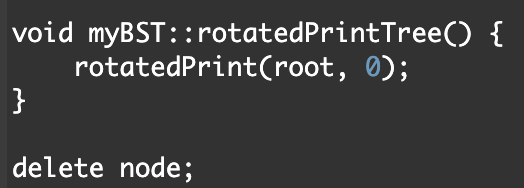
Lastly, I created a rotational tree-printing function that shows the BST's structure graphically. Users can inspect the tree layout, carry out traversals, and look for certain keys once the tree has been built. In order to guarantee that all dynamically allocated nodes were correctly erased when the program ended, I additionally implemented a destructor and a recursive memory cleanup method.
This stage demonstrated how binary search trees store data and reaffirmed the significance of memory management.
Binary Search Tree Implementation and Traversal in C++