
IEEE-754 Floating-Point Overflow Detection
Overview
For this project, I created a C++ software that examines IEEE-754 single-precision floating-point integers to see if adding a floating-point value inside a loop repeatedly could cause overflow or accuracy loss. Instead than just doing math, the program extracts the sign bit, exponent, and fraction straight from memory to analyze the intrinsic binary representation of floating-point data.
The loop counter (the value added during each iteration) and loop bound (the number of loop iterations) are the two command-line variables that the program takes. It determines whether the loop bound exceeds the range where floating-point precision can safely represent each increment and computes the overflow threshold using IEEE-754 encoding standards. My knowledge of IEEE-754 standards, binary representation, bit manipulation, floating-point arithmetic, and low-level computer architecture has all improved as a result of this effort.
Tools and Technologies Used
-
C++
-
IEEE-754 Floating-Point Standard
-
Bit Manipulation
-
Bitset Library
-
Unions
-
Command-Line Arguments
-
OnlineGDB
-
Computer Architecture
IEEE-754 Single-Precision Floating Point
Sign | Exponent | Fraction
1 bit | 8 bits | 23 bits
-
Sign Bit determines whether the number is positive or negative.
-
Exponent stores the magnitude using a bias of 127.
-
Fraction (Mantissa) stores the significant digits of the floating-point number
Threshold Exponent

The overflow threshold was calculated by determining the exponent of the loop counter.
If the floating-point value contained fraction bits, the exponent was increased by one to account for the additional precision required.
Stored Exponent

IEEE-754 stores exponents using a bias of 127.
Key Steps
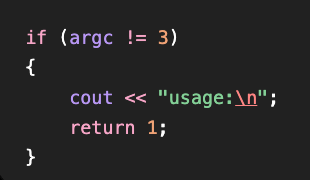
1. Read and Validate User Input
Initially, I designed the program to take two command-line parameters: the loop counter and the loop bound. The program checked that exactly two values were entered before beginning any computations. The application showed instructions outlining the necessary input format if improper arguments were entered.
This made sure the program always got the data it needed to accurately assess the floating-point numbers.
2. Display the IEEE-754 Binary Representation
I utilized a union to retrieve the precise binary representation kept in memory after reading the input values. Each floating-point integer was transformed into a 32-bit bitset by the program, which then individually displayed the sign, exponent, and fraction bits.
Instead of only seeing the decimal values of floating-point numbers, I was able to see how the processor represents them inside.

3. Extract the Exponent and Fraction Fields
I then used bitwise operations to directly extract the exponent and fraction from the floating-point number. I computed both the stored exponent and the actual exponent used by the floating-point representation by shifting and masking individual bits.
In order to ascertain whether further precise adjustments would be necessary for determining the overflow threshold, I additionally isolated the fraction bits. This step improved my comprehension of bit manipulation and low-level data representation.
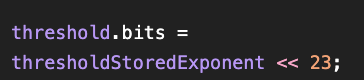
4. Calculate the Overflow Threshold
I determined the threshold at which floating-point accuracy starts to lose its capacity to accurately represent each increment after extracting the exponent information. The program directly recreated the matching floating-point value from its binary form after calculating the threshold exponent using IEEE-754 standards.
This illustrated how binary fields can be manipulated to produce floating-point values without the need for conventional arithmetic operations.
5.Detect Potential Floating-Point Overflow
Lastly, I contrasted the computed threshold value with the user-specified loop bound. The application warned that floating-point accuracy could no longer reliably represent each increment if the loop bound was greater than the threshold. Otherwise, it stated that there was no overflow found.
In order to help users understand why the overflow alert happened, the application additionally showed the threshold value and its IEEE-754 binary representation. This effort showed how binary analysis, as opposed to runtime experimentation, may forecast floating-point constraints.
Results, Analysis, and Further Reading
This project illustrated how the IEEE-754 standard is used to internally represent floating-point numbers and how those representations affect computational precision. I gained a better knowledge of binary data format and floating-point arithmetic by looking at the sign, exponent, and fraction fields straight from memory.
The program predicted when floating-point precision could become incorrect by analyzing the underlying bit patterns rather than depending just on numerical computations. I improved my knowledge of computer architecture, bit manipulation, low-level programming, and troubleshooting numerical calculations through this project.